
Learning

Royce Ferguson in Action

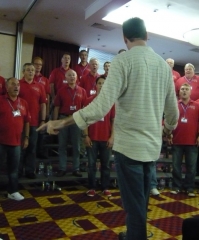
Royce Ferguson with the Cottontown ChorusRoyce Ferguson with the Cottontown ChorusAt the BABS convention last week I had the opportunity to observe Royce Ferguson coaching Bolton’s Cottontown Chorus. Royce is best known in the barbershop world as the director who took the Westminster Chorus to their first two international chorus medals in 2006 and 2007. It is not surprising therefore that he is in considerable demand as a coach and he is becoming a regular visitor to the UK in that capacity.

In his work with Cottontown he focused on the integrity of tone, on maintaining a sound that was neither breathy nor pushy. Indeed, he identified putting energy behind a breathy tone as the primary cause of vocal strain. He relentlessly insisted on a refinement of tone in which the voice is ‘always connected but never heavy-handed’. It is an active tone, not a passive one, which needs constant attention to keep it centred. He talked a lot about letting the natural beauty of the sound resonate without feeling the need to do things to it:

Art & Education

I was recently asked to write a reference for a barbershop chorus that was applying for charitable status, in response to the following question they had been asked:

Please provide independent expert evidence to show the performances are of sufficient educational merit to raise aesthetic taste.

As it happens, it’s quite a good chorus, so I could happily write in their support, and it’s quite easy to point to reasonably objective level indicators with barbershop, because the contest system is so effectively standardised internationally. The criteria are so explicit and the training regimens so thorough, that you can look at a collection of scores and articulate in some detail what they say about performance quality.

But what I found interesting was the set of assumptions built into the question.

Into the Zone

zonesI’ve mentioned before some of the useful conceptual contributions that Chris Davidson made to BABS Directors Colleges over the years, especially with introducing chorus directors to Kotter’s model of how to effect change. This diagram was another model he presented that is just one of those ‘oh yes that describes exactly how the world is’ type ideas.

So the first thing it tells us is that in order to learn anything, we have to get out of our comfort zones. That sounds kind of obvious, except that most people are very happy to spend a lot of their time studying/rehearsing/practising doing routine things in a generally comfortable way and kidding ourselves that we’re making progress. And because we’re involved in some kind of activity we’ve labeled ‘work’, we can feel nice and virtuous about what we’re doing without encountering anything that is going to threaten our egos. (This is why I spent so much of my youth practising scales.) If we want to learn, rather than simply reconfirm our current skills, we need to get out of our psychic armchairs.

How can I retain what I’ve learned?

Retention is the Achilles heel of a performance coach. It’s one thing to go and help an ensemble significantly improve their performance, but unless the coaching results in some kind of longer-lasting improvement, it has not done its job. It may of course have given the singers a good time, so was still a valid use of the session - but there is a difference between a fun workshop and coaching.

There are a number of elements or stages to the process of retention, and I suspect that the secret lies in combining them effectively.

Obsessiveness, Reluctance and Excellence

When I was organising the mutual mentoring scheme for arrangers, I had several conversations in which people said words to the effect of, ‘Oh, I must get round to doing some arranging’. I found this an interesting response because it is so different from my own relationship with arranging – which is probably best described as compulsive.

My first reaction was more judgemental than I like to admit: that the response was tantamount to an admission of mediocrity. If an activity is something you feel you should get round to, you’re just not doing it enough to be any good at it. You just wouldn’t say that if the activity was a regular part of your life’s activity.

Then I noticed I was being uncharitable, so tried to think a bit more openly about it.

Mixing Music-readers and Ear-singers

One of the constant challenges the director of an amateur choir is likely to encounter is how to work with a group that includes both people who read music and people who don’t. The two constituencies can have quite different learning styles and preferences, and you want to find learning strategies that work for both.

Back in Amersham

Amersham A CappellaAmersham A CappellaI spent last Tuesday evening with my friends Amersham A Cappella, who had extended their usual rehearsal time and sacrificed their tea break in order to fit in as much coaching time as possible. The main agenda for the evening was working on an up-tempo number that they learned last year intending it for contest, but mothballed when it didn’t quite come into focus. So this was music they knew quite well – they weren’t struggling to remember notes and words – but did not have an ingrained imaginative or interpretive approach to it. In other words, it was ripe for an investigative session – indeed, the singers’ palpable desire to pull it into shape is what made the evening really productive.

We found ourselves using filmic metaphors frequently – not an unusual technique for me, but the results were quite striking and got me reflecting on the ways in which they work. There were three dimensions they were helping us in on this occasion.

How much do we know what we’re doing?

John Mayer: music as intellectJohn Mayer: music as intellectAndrew Downes: music as feelingAndrew Downes: music as feeling

At one point we had a pair of composition teachers at Birmingham Conservatoire who seemed to get on very well, but nonetheless had diametrically opposed views about how we should approach music. John Mayer used to harangue me over the photocopier about how music was nothing to do with the heart, but was an intellectual pursuit, while the then Head of Composition and Creative Studies, Andrew Downes used to say that you should never analyse anything, it should all come from the heart.

...found this helpful?

I provide this content free of charge, because I like to be helpful. If you have found it useful, you may wish to make a donation to the causes I support to say thank you.


Archive by date

Syndicate content Syndicate content