

Musical Identity

Questions of Blend

A recent comment on a post from last year asked the following question:

I have tried twice without success to join choirs that do 3 and 4 part harmony. I get rejected after a few sessions as i am told my voice does not blend. I know I have a good singing voice and i am very motivated, although I do not understand very much about music theory

The last attempt did not lead to any criticism from the coach but from the other singers near me. I am puzzled as to the possible cause of non blending. Any advice?

I felt it was one of those questions that deserves a post (or possibly a book) in its own right.

123…Come & Sing!

123sing
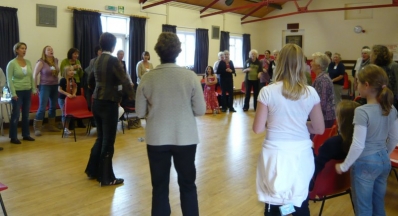
Last weekend saw singing events taking place all over the UK as part of Classic FM's 123sing! project. My contribution to the extravaganza was leading a Come & Sing workshop in Appleton, a medium-sized village in Oxfordshire. The workshop was organised and hosted by Harmony InSpires, the ladies barbershop chorus that rehearses in the next village, and through a combination of leafleting, advertising and word-of-mouth they pulled in a good sized group of participants.

On Presence

I recently received an email from Dr Carl Smith, a choral director based in El Paso, discussing among other things ideas from the book Authentic Happiness by Martin Seligman. In particular, he was interested in the idea of ‘savoring’, and how that might intersect with the conductorly notion of charisma. He said:

To Seligman, "savoring" is is "...the awareness of pleasure and of the deliberate conscious attention to the experience of pleasure." Perhaps another way to describe the term is "being in the moment."

I have very recently learned (and am STILL learning!) to focus on what is happening right in front of me NOW and enoying the pleasure. In choral rehearsal at with the small church choir I conduct, it means to listen intently with a smile and with positive feedback to myself and the singers. IS THAT A PART OF "CHARISMA?"

My immediate response was: good question.

Creativity and Genre

In a comment on my last post, Chris Rowbury made the following point:

Re: listening to other people's work. I agree up to a point. An analogy: when play writers want to get stuff onto Radio 4, they are encouraged to listen A LOT to the afternoon play. What then happens is they end up writing stuff that sounds just like all the other stuff in that slot. You can spot a Radio 4 afternoon play a mile off. I can spot a barbershop arrangement a mile off. But I sit up and notice when something is REALLY original.

I started to reply to him there, but his point is so interesting that I decided to focus on it for a whole post in its own right.

Start as you mean to go on

This post is a theme that emerged during my visit to Bristol Fashion last week, but which wanted enough thinking about to deserve a post of its own. It is, on the face of it, a rather obvious point: that if a chorus starts a phrase well, it continues well, whereas a hesitant or ragged or inattentive start leads to a lower level of performance throughout the phrase. This resonates with my observations of how one of the ways Peter Kennedy maintains performance standards at Green Street Blues is by not letting them continue after a substandard start. But it also brings out some extra dimensions that you can only spot when you can compare the continuations from both clean and rocky starts.

Tone, Articulation & Venue

In a comment on Thursday’s post on the Cheltenham Festival, my friend Sarra remarked on the subject of staccato singing:

… it's possible that in a very echoey space with many singers unused to such an acoustic, and preparing a performance in three days, it might be what you need. Just about.

On reflection it's a bit like running a car with vital bits tied on by string. :)

This reminded me that I’ve been intending to blog someday about the relationship between performance styles and the typical venues in which they’re found. Looks like someday has arrived.

Sweet Adelines at Gateshead

The Sage CentreThe Sage CentreLast weekend saw the Sweet Adelines Region 31 convention come to Gateshead. The Sage Centre is a great venue for this kind of event, with auditoriums designed to make live music sound wonderful, and plenty of common social spaces for people to hang out together between the performances. It’s a pity, from a convention experience perspective, that the Quartet of Nations region won’t be able to come back here in future, though I’m sure everybody is delighted about the significant increase in membership that means they’re growing out of the venue.

The ‘C’ word, ‘F’ word and how to deal with stereotypes

In a post about ‘The ‘C’ Word’, Chris Rowbury opens up the thorny question of cultural stereotypes as they relate to choirs. He identifies a handful of stock images that leap to mind when people hear the word ‘choir’ and talks about he finds them limiting – both because they focus on a hackneyed subset of actual choirs, and because they carry somewhat negative connotations with them. He finds himself, not unreasonably, rather wearied with the assumptions people make about him as a choral practitioner, since they are both rather inaccurate and presuppose a rather less interesting musical life than the one he experiences.

The strategies he proposes for dealing with the limiting stereotypes of the word ‘choir’ are all sensible as far as they go.

...found this helpful?

I provide this content free of charge, because I like to be helpful. If you have found it useful, you may wish to make a donation to the causes I support to say thank you.


Archive by date

Syndicate content Syndicate content