
Performing

Singing Long Phrases

I’ve had several conversations with members of Magenta recently in which someone has said that they find it hard to have enough breath to last to the end of the phrase. In any choir, breath control is an ongoing project, but it is also something that individuals can continue between rehearsals. So this post is for them, and for anyone else who has ever run out of breath early (so that includes me, then….).

The End of Early Music?

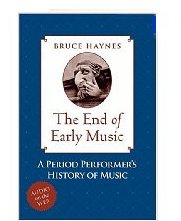
Haynes2007I’ve been dipping into Bruce Hayne’s 2007 book The End of Early Music, and enjoying it in a somewhat argumentative way. It’s written in a lively fashion, in the tradition of and strongly influenced by writers such as Christopher Small and Richard Taruskin – writers who like to take what we thought we knew and reinterpret it until they jiggle us out of our complacency.

Some people find this kind of style irritatingly unscholarly, but it’s great teaching material. Nothing like a spot of outrage to awaken the critical faculties, after all. So I find it easy to like a book that includes sentences like: ‘There was a time when “AUTHENTIC” sold records like “ORGANIC” sold tomatoes’.

Musical Sense and Poetic Sense

A criticism levelled at amateur singers* is that their ideas of how to interpret songs are led almost entirely by the lyric with little concept of how to handle musical elements. Indeed, I have myself critiqued approaches to interpretation that are story-led to the exclusion of everything else. But surprisingly often you hear phrasing that cuts across the sense of the lyric – breaths that cut a sentence in two, or commas sung through as if the two clauses belonged together.

I think this happens mostly in places where the surface structures of lyric and music don’t completely coincide. The singers subconsciously parse the phrase structure into its simplest musical structure – and in its extreme form, this comes out in the nursery-rhyme phrasing I wrote about back in October. But there are more sophisticated versions of this. For example:

Piano Revelation

Out with the old...Out with the old......and in with the new...and in with the new

I bought a new piano recently. The one I grew up with (a hand-me-down from my great aunt) has done sterling service, but I have grown out of it. Since I’ve stopped working in a music college, where I had a lovely Yamaha upright in my office, I’ve been finding I miss being able to play a good instrument. It’s a long time since I’ve been playing at anything like a professional level, but pianism is still an important part of how I think.

Anyway, I had a mild revelation while talking to my mum about the quality of my old piano – the ways in which it’s okay, and the ways in which it’s limited.

Soapbox: The SAI Show Package Final

soapboxI spent some of last weekend watching and listening the webcasts from the Sweet Adelines Convention in Nashville, and the ‘show package’ finals had me thinking again about the nature of entertainment and its relationship with competition. I’ve had these thoughts before, but I thought I’d mention them now as they’re current.

Ladysmith Black Mambazo at Symphony Hall

Last Friday, I went with my friends from Magenta to see Ladysmith Black Mambazo at Birmingham’s Symphony Hall. Having heard their sound, both from their own albums and from their collaborations with Paul Simon, I found it something of a revelation to see how they perform too.

Programming Music History

Alan Davis wrote a blog post back in 2008 about programming, and raised the question about the order of pieces in a mixed programme. His first instinct was to arrange the pieces, which ranged from the 17th to the 20th centuries, in chronological order, but he was also wondering if there were other ways to sequence them that would give a different perspective on them.

It's a more interesting question that it appears on first glance, and it has stayed with me for some time. My initial response was that chronological would raise no eyebrows – since everyone seems to use chronological order – but that it was commensurately the least interesting approach. But two rather more interesting thoughts lurked behind this knee-jerk response, and I’d like to tease them out.

Sunday Night at the London Palladium

Last Sunday, the best of British barbershop conspired to present a show at the London Palladium as the climax to the national ‘barbershop awareness week’. I had a couple of personal highpoints, with NoteOrious and Eu4ia both singing my arrangements – the latter having commissioned theirs specifically for this show (Christine Aguilera's 'Candyman').

It was a long show – a good three hours – but it did a very good job of sustaining interest. Given that all the acts were from basically the same kind of a cappella world, this is a testament to some very effective programming – it could have become very samey, but didn’t. I’ve been finding it useful to analyse what went in to making the structure so effective.

...found this helpful?

I provide this content free of charge, because I like to be helpful. If you have found it useful, you may wish to make a donation to the causes I support to say thank you.


Archive by date

Syndicate content Syndicate content