
Musical Identity

Is Music Education a Waste of Public Money?

Last week I heard from a friend about an experience that was bothering her 17-year-old son. He’s currently studying for A levels, and planning to apply for a place on a BMus course. His career aspirations seem quite clearly thought-through (way more than mine were at that age!), with a desire to perform professionally backed up by Plans B and C of teaching music and/or doing something else to pay the bills while moonlighting on the semi-pro circuit.

The first thing to note is that Plan A will almost certainly involve either or both of Plans B and C en route. Very few people support themselves throughout their career entirely from performing. It’s not just when you’re in the early stages needing to supplement income either. You also see people shifting away from full-time performance later on, in order to see their kids before they grow up, or for the chance to spend a bit of time enjoying the house they’ve been paying the mortgage on.

Anyway, that’s the background; the problem is this:

Suitability to Performer

Years ago I was watching one of the piano classes at the Colchester Festival, in which I had a piano student performing. One of the other entrants played the first of Debussy’s Arabesques. He was accurate, but ploddy, showing little of the sense of sweep and flow the music calls for. My first thought was: ‘What on earth is his teacher doing letting him loose on this?’ My second thought, following hard on the heels of this was: ‘I know exactly why his teacher wanted him to learn this.’

This experience highlighted the contradictory nature of two standard imperatives in the development of musical performers. On the one hand, people are encouraged to perform music that ‘suits’ them; on the other, people are encouraged to engage with a variety of styles and expressive worlds in order to develop breadth and flexibility of communication.

Spooked!

The Spooky Men's Chorale in performance at the end of the workshopThe Spooky Men's Chorale in performance at the end of the workshop
I spent last Saturday morning at a workshop by the Spooky Men’s Chorale entitled ‘Sing Like a Bloke’. It was hosted by Sounds Allowed, and had been preceded the night before by a concert (which I’d missed through trying to book tickets after it had already sold out). Birmingham was the first stop in a tour of the UK, which continues right through into September.

As it turned out, the gender implications of the workshop’s title didn’t play a major part. It was more a case of learning to sing in the style that this particular set of people, who happen to be blokes, do. This style draws heavily on the vocal production of the Georgian choral tradition; indeed apparently they referred to themselves as ‘post-Georgian’ in the concert, which opened up all kinds of interesting conversations about being post-a place. I think I may take to being post-English on the same principle.

The 5-30 Practice Programme: The Results, Part 2

On Sunday I reported on how the participants in the June singing practice experiment wrote about their experience of maintaining the habit of five minutes singing practice a day.

Feedback on the effects of the practice regime

By definition there’s less of this, since only those who did much practice were able to feed back on it.

The headline result is that, yes, five minutes a day does seem to make a difference. And the difference is discernible after a week. One respondent who fell by the wayside towards the end of week 2 reported that she was ‘starting to think it was all very helpful’ at the end of the first week. Another noted at the 1-week mark that she:

Noticed at rehearsal that I'd retained odds and ends we worked on the week before (correcting notes, where to breathe etc) because I'd practised it several times. I felt quite virtuous!

The 5-30 Practice Programme: The Results, Part 1

So, here are the outcomes from the reports sent in by participants in June’s singing practice experiment. There are a few notable (and gratifying!) overlaps with my predictions, but also some interesting things I wouldn’t have guessed. Which is why it is worth asking people about their experience of course - so as not to fall down the hole between theory and real life!

The first striking thing was actually how few people did send in reports. I don’t think this was because nobody knew about it. For one thing my website stats reassure me that people are at least visiting the site in some numbers, and 154 of those visits were straight to one or other of the two posts about the experiment. For another, I had quite a few people tell me that they were forwarding the links to other people they sang with. This latter point also suggests that at least some people thought the idea worth engaging with.

Cultural Hierarchies and Bling

I’ve been thinking recently about the visual dimension of musical performances, and cultural attitudes about High Art and vulgarity. The immediate spur for these thoughts was the Sweet Adelines convention in Birmingham, but they’re also plugging into things I’ve been thinking about at least since my PhD days.

So, the concern with costume and make-up and general blingification is of course the aspect of barbershop that people affiliated with other genres sometimes take as evidence of triviality. It’s The Music that matters, they say, not all this frippery stuff. Diamante earrings and choreography are tricksy things in this view, at best distracting the audience from the Real Thing that is The Music, and at worst trying to disguise the fact that the music isn’t very good. It’s all style-over-substance, is the criticism.

A Special Weekend

Cottontown flying kites to finish their show setCottontown flying kites to finish their show setLast weekend saw British barbershoppers descend in droves on Llandudno for the 2011 BABS convention. This one was a special one for me in several ways. First, because I had the honour of hearing no fewer than eight of my arrangements receive their first performances. Five were in the chorus contest (sung by Telfordaires, Tuxedo Junction and the Cottontown Chorus), one in the quartet finals (sung by the Serious Chord Squad), and two in the Sunday afternoon show. Current LABBS gold medallists Amersham A Cappella and retiring BABS champs, the Great Western Chorus, also aired arrangements of mine in the Saturday night show.

Sweet Adelines in Birmingham

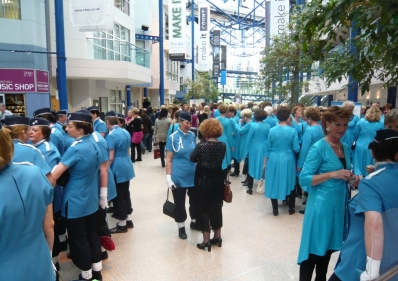
Symphony Hall's central thoroughfare, thronged with chorus singersSymphony Hall's central thoroughfare, thronged with chorus singersThe weekend saw Sweet Adelines Region 31 come to Birmingham for their annual convention. Symphony Hall is an expensive venue for this kind of event, but it does provide a wonderful environment. It’s not just that the auditorium is designed so well for acoustic performance (the judges remarked they’d never been at a contest venue of this size before without people needing amplification), but the social areas are so nicely integrated into the city. Of course I could be biased about my home patch, but I’d like to think I’m grateful for good venues wherever they can be found!

Both quartet and chorus contests were of an impressive quality. Both had clear winners out in front of the pack (Finesse and Forth Valley Chorus respectively), but 2nd-5th places were hotly contested in both competitions, giving a real excitement to the results. And in the lower-placed ensembles, all the performances were of creditable quality – all managed to make entertaining contributions to the weekend.

...found this helpful?

I provide this content free of charge, because I like to be helpful. If you have found it useful, you may wish to make a donation to the causes I support to say thank you.


Archive by date

Syndicate content Syndicate content