
Performing

On Editorial Oppression

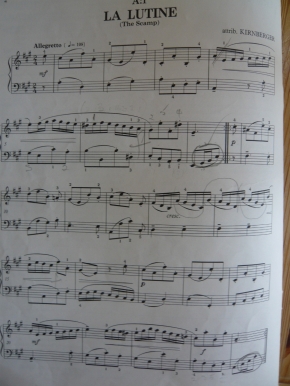
Another page from my childhood repertoireAnother page from my childhood repertoireWhen I was looking back at my childhood piano music last month, it wasn’t just the admonitory annotations that leapt out at me. I also found myself quite boggled to see quite how much editorial stuff had been added to the older pieces. Articulation, phrasing, dynamics, all kinds of stuff in profusion. I had forgotten that music used to look like this.

And you know what? I felt really boxed in by all those extraneous instructions. It was almost hard to read the notes for all the lines and dots and other paramusical paraphernalia. I hadn’t noticed how accustomed I have become to modern editorial habits that aim to strip out all the accretions of time and get back as close as possible to the text the composer produced (and to provide footnotes to tell you where the editor is having to make a guess).

Performing in Anticipation

There’s a Jonathan Coe novel in which a character says something like, ‘I shall enjoy looking forward to that’.* The main protagonist is struck by the multiple layers of anticipation built into the statement - taking pleasure in anticipating the pleasure of anticipating something. This quote came to mind as I was noting the various types of future-orientation discussed at Karen O’Connor’s Performing On Your Mind workshop back in November.

The first was the envisioning process entailed in the general coaching strategy, asking performers to describe the kind of performance they would like to give. I have already discussed how this serves to focus attention on solutions rather than problems, but it’s interesting to note that it thereby gets the performer to construct an imagined future self who is fulfilling their present ambitions.

Performing at Trigger Point

Magenta's primary triggerMagenta's primary triggerOne of the techniques from sports psychology that Karen O’Connor shared in her Performing On Your Mind workshop was the use of triggers, or cues. For me, this was one of those lovely moments when a concept crystallised out aspects of my own praxis. By naming the tool, it became possible to analyse it - and also to see ways in which I can apply it more tactically.

(Which is, if you think about it, what a coach is doing a lot of the time anyway: making things that a performers is experiencing perceptually available, and thus also conceptually available. Actually, that’s the function of music analysis too - I hadn’t spotted that parallel until I started this paragraph.)

On the 'Thought Point'

This is another of those posts bringing together bits and bobs from coaching reports about an idea (such as here and here) into one place so I can point to it and say: there, that's where I explain what this is.

The 'thought point' is a concept I have been playing with for a number of years, ever since I first came across David McNeill's concept of 'growth point' - the moment when a thought starts to occur to us. In real-life conversation, you have an inkling first, a motivation, a sense of instability that demands expression. If someone interrupts you before you get to express the idea, you may find it disappears entirely - it is not yet a fully-fledged thought, only the potential for one.

Meet Your Chimp

chimp

One of the models that Karen O’Connor shared at her Performing On Your Mind workshop last month was a way of conceptualising different functions of the brain developed by sports psychologist Steve Peters. He divides the brain into three main areas, the frontal region, which operates the logical functions, the limbic region, seat of the emotions, and the parietal region, which acts as storage.

As Karen’s slide (which she has kindly let me share with you) shows, he then characterises these as your ‘human’ brain, your ‘chimp’ brain and your ‘computer’. This is clearly a simplified model of the brain, but its usefulness lies in its very simplicity - and it does at least bear a somewhat more direct relationship with the underlying complexities than the old stereotype of left and right hemispheres. (Which itself has some similarly valuable uses as a reflective tool - it’s just taken rather too literally rather too often.)

Singing, Movement, and Depth of Learning

My recent workshop on voice and movement with Zemel Choir and their workshop guests have given me lots of food for reflection. I am very accustomed to using movement and gesture as rehearsal tools, as well as working with groups that use choreographic presentations as a matter of course. I am less accustomed to introducing these elements to a choir that does not have an established history of them, though.

This means that I have had the opportunity to learn lots about people’s reactions and modes of learning when starting from scratch. (There are echoes here of my session with Cleeve Harmony back in October - it is one thing to teach something when people know what they’re after and just want to learn how to do it, it is quite another when you have to help them imagine as well as execute the vision.)

Thoughts on the Mixed Quartet

This year's winners, PatchworkThis year's winners, Patchwork

LABBS Convention this year saw the UK’s second mixed quartet contest, following on from last year’s inaugural event. The standard was once again good, and the audience support enthusiastic, so it looks like it could be finding itself a regular fixture in the British barbershop year.

I reflected at some length after last year’s contest on the gender identity and voice-part identity interplays and instabilities that the genre brings out, and this year’s impressions are on similar themes.

Celebrate with Singing and Movement

Every year, Zemel Choir holds workshop day called ‘Celebrate with Song’ at which they invite visitors to join them for a day of music-making in preparation for a concert a couple of weeks later. This year, they invited me to come and lead a workshop on ‘Singing and Movement’ during the afternoon. It ran twice, each time with half the participants, while the others spent the time with expert on Russian and East European traditions of Jewish music, Polina Skovoroda-Shepherd.

Short workshops like this always present of the dilemma of how you balance the big-picture value of exploring skills and ideas with the goal-directed needs of preparing people for a performance. This dilemma is heightened when a significant number of participants have a relatively brief space of time in which to absorb all the repertoire in the first place - they may not have a lot of cognitive space left to think about other parts of the body.

...found this helpful?

I provide this content free of charge, because I like to be helpful. If you have found it useful, you may wish to make a donation to the causes I support to say thank you.


Archive by date

Syndicate content Syndicate content