
Add a comment
On Editorial Oppression
‹-- PreviousNext --›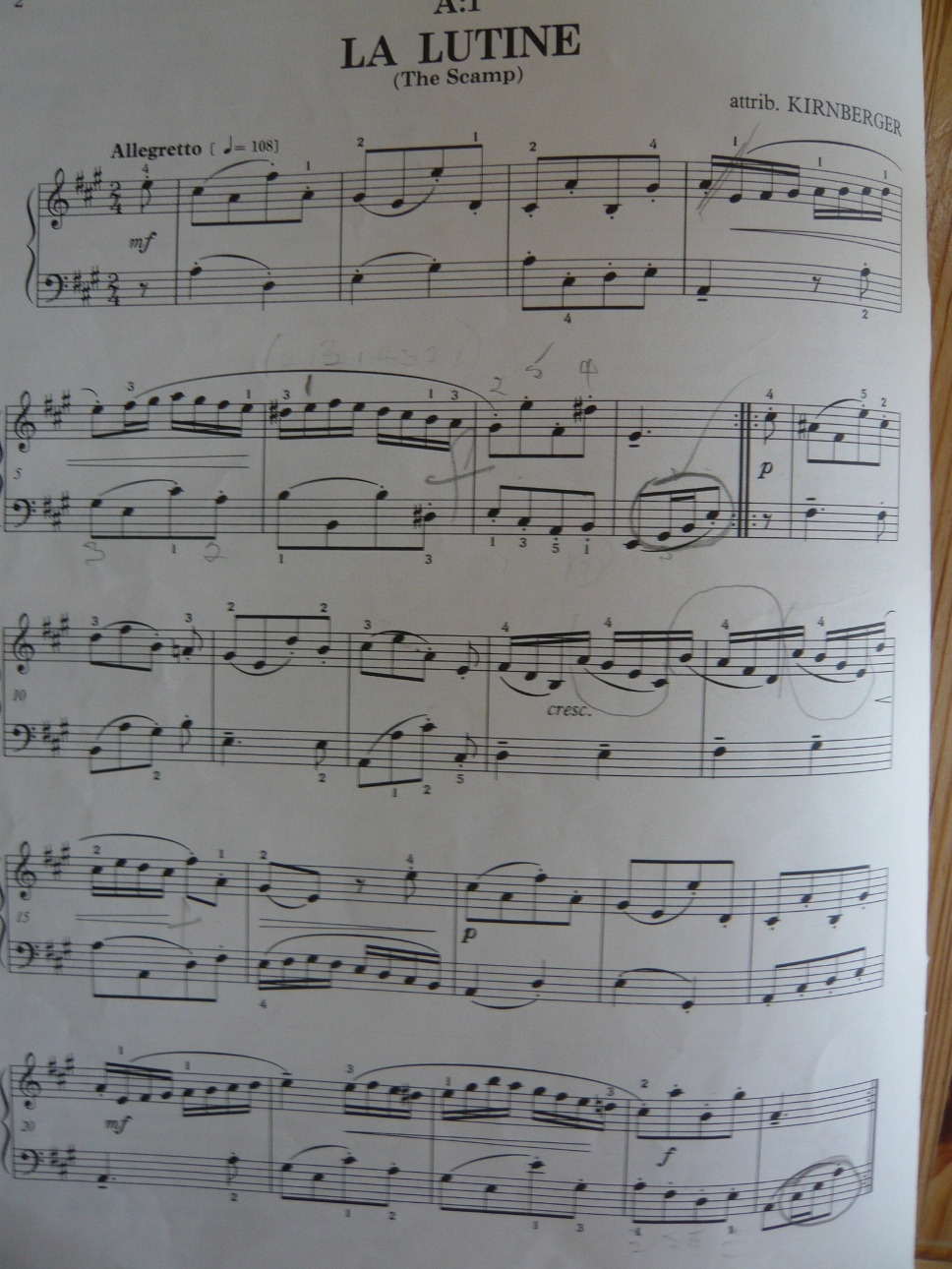 Another page from my childhood repertoireWhen I was looking back at my childhood piano music last month, it wasn’t just the admonitory annotations that leapt out at me. I also found myself quite boggled to see quite how much editorial stuff had been added to the older pieces. Articulation, phrasing, dynamics, all kinds of stuff in profusion. I had forgotten that music used to look like this.
And you know what? I felt really boxed in by all those extraneous instructions. It was almost hard to read the notes for all the lines and dots and other paramusical paraphernalia. I hadn’t noticed how accustomed I have become to modern editorial habits that aim to strip out all the accretions of time and get back as close as possible to the text the composer produced (and to provide footnotes to tell you where the editor is having to make a guess).
Now, the discourse around the editing of early music and the associated historically-informed performance practices have tended to be framed in terms of authenticity. Even though that actual term has largely been dropped as embarrassingly over-idealistic, there is still a sense that fidelity to a composer’s intentions and/or expectations is the imperative that drives the process.
Hence, the visual purity of a score untouched by modern expression marks has carried connotations of a purity of purpose - nothing must get in the way of our veneration of the composer’s Idea as it was conceived. This is an ideal I have tended to take with a pinch of salt - indeed, I always rather enjoyed baiting over-serious students on the issue. Nonetheless, I have tended to favour these cleaner scores where possible, as I’d always prefer to know when I’m making fast and loose with the text. It seems I have come to regard them as the norm.
But when faced once again with the mid-20th-century style of over-editing, I suddenly saw the Urtext in a new light. By removing the interventions of intermediaries between composer and performer, these editors have not just been aiming to restore the authority of the composer, they have also been restoring the agency of the performer.
Because there are multiple ways one can articulate an 18th-century piece. And in the 18th century, it would have been the performer’s job to decide which of the available possibilities to go for. They would parse the harmonic, rhythmic and motivic structures presented and shape them so as to make sense of them. An editor who fills the copy with ‘expressive markings’ is thereby usurping that role - in fact significantly limiting the performer’s opportunity to make expressive decisions.
Whereas a clean score facilitates Peter Katin’s marvellously atmospheric interpretations of Scarlatti as much as it does Trevor Pinnock’s historically punctilious ones.
It does make you wonder what happened such that editors stopped trusting novice musicians to become musical - that is, to develop an understanding of meaningful musical shape and delivery. Or maybe they didn’t trust teachers to develop this quality in their charges. I guess it happened at the same time as both the massive expansion of musical participation that arose with the industrial revolution and mass-production of instruments and with the increased specificity in the new works being produced by composers.
(At the back of my mind throughout this has been the question as to how I feel about expressive markings in later music, which will generally have been put there by the composer. I don’t find these such a barrier, though I’m not sure why. It may be because I am subconsciously admitting the composer’s authority to make these decisions for me. But I think it is also because these markings are generally more integrated with the structure - pointing up changes in texture, rhythm, etc - rather than just layered onto a musical structure that can stand as complete in itself.)
But I find it telling that the places where my adult musical judgement tends to disagree with the editorial markings are the places where my teacher’s annotations on my childhood scores suggest I was having most problems obeying them.


You may also like ...
|
Node 1,773
Weight = 6. Linked from Making Dynamics Dynamic (4), Two tags in common [35 posts have this] Aesthetics, Performing (2) 
|
Node 1,624
Weight = 6. Linked from On Artistic Freedom (4), Two tags in common [35 posts have this] Aesthetics, Performing (2)
|
Node 1,586
Weight = 3. Links to Performing at Trigger Point (2), One tag in common [291 posts have this] Performing (1) 
|
Node 1,115
Weight = 2. Two tags in common [35 posts have this] Aesthetics, Performing (2) 
|
